


RPE and RIR explained
RPE and RIR let you set training weight by how hard a set feels, so the weight follows your day instead of a fixed number.
What they mean
- RIR, reps in reserve: how many more good reps you could have done when you stopped the set.
- RPE, rate of perceived exertion: a 1 to 10 rating of how hard the set was. In strength training it is usually tied to RIR: 10 means no reps left, 9 means one left, and so on.
This RIR-based RPE scale was described by Zourdos and colleagues in 2016 and explained for coaches by Helms and colleagues the same year.
The RIR-based RPE scale
| RPE | Reps in reserve | What it feels like |
|---|---|---|
| 10 | 0 | Could not do another rep |
| 9.5 | 0 | Could not do another rep, but could have added a little weight |
| 9 | 1 | One more rep was left |
| 8.5 | 1 to 2 | Maybe two more reps |
| 8 | 2 | Two more reps were left |
| 7.5 | 2 to 3 | Maybe three more reps |
| 7 | 3 | Three more reps were left |
| 5 to 6 | 4 to 6 | Moderate effort |
How to rate a set
- Finish the set with good form.
- Ask yourself honestly: how many more clean reps could I have done?
- Write down that number as RIR, or convert it: RPE = 10 minus RIR.
- Next session, use it: if a set meant to be RPE 8 felt like RPE 6, add weight; if it was RPE 10, hold or reduce.
Ratings are less reliable when you are new to a lift or far from failure. Occasionally taking a final set to a true limit (safely, with a spotter or safety bars) shows you what "zero in reserve" actually feels like.
Why train by effort
Sleep, stress and fatigue change how strong you are on a given day. A percentage of a max tested weeks ago does not know that; an RPE target does. RPE also pairs naturally with progressive overload (add weight when the same work feels easier) and with spotting when you need a deload (when the same work keeps feeling harder).
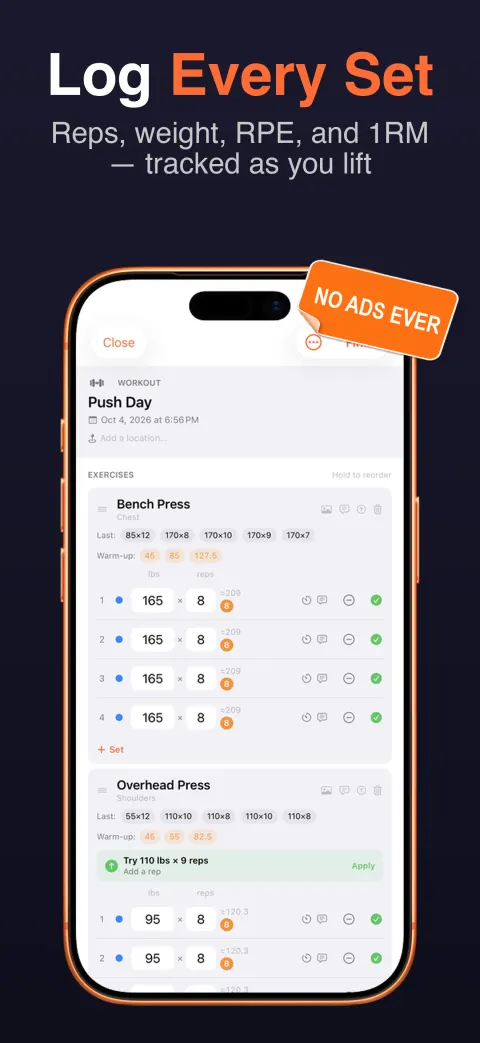
Log RPE on every set
Lift Pro adds a 1 to 10 RPE rating to each set, and uses it so it doesn't suggest more weight after a grinder.


Frequently asked questions
What is the difference between RPE and RIR?
They describe the same thing from opposite ends. RIR counts the reps you had left; RPE puts that on a 1 to 10 scale where 10 means no reps left. RPE 8 is 2 reps in reserve.
Is RPE accurate for beginners?
It takes practice. Rate every working set, and now and then compare your rating with what actually happened (for example, when a final set is pushed to the limit safely). Over a few weeks your ratings get more consistent.
What RPE should I train at?
Most working sets in common programs land around RPE 7 to 9 (1 to 3 reps in reserve), with fewer sets taken to RPE 10. Follow what your program prescribes.
Does Lift track RPE?
Yes. Lift Pro lets you rate each set from 1 to 10, and its progressive overload suggestions can skip increasing the weight when your last RPE was high.
Sources
- Zourdos MC, et al. Novel resistance training-specific rating of perceived exertion scale measuring repetitions in reserve. J Strength Cond Res 2016;30(1):267-275
- Helms ER, Cronin J, Storey A, Zourdos MC. Application of the repetitions in reserve-based rating of perceived exertion scale for resistance training. Strength Cond J 2016;38(4):42-49