


Progressive overload
Muscles adapt to what you ask of them. Progressive overload means asking for a little more over time, so they keep adapting.
What it is
If you lift the same weight for the same reps every week, your body has no reason to change. The American College of Sports Medicine's position stand on resistance training calls progressive protocols "necessary" to keep adapting toward a training goal.
Ways to progress
- Weight: the same sets and reps with a heavier load.
- Reps: more reps with the same load, inside a target range (for example 8 to 12), then add weight and drop back to the bottom of the range. This is called double progression.
- Sets: one more set of an exercise.
- Frequency: training a muscle or lift on more days per week.
- Effort: the same weight feeling easier, measured with RPE or RIR, is progress too, and a signal to add load.
How much, and when
The ACSM position stand recommends a 2 to 10% increase in load when you can perform the current workload for one or two repetitions over the desired number. For a beginner, that often means adding the smallest available jump every session on the big lifts. Intermediate lifters progress more slowly, week to week or block to block.
Target: 3 sets of 8 to 12. Week 1: 135 lb for 9, 8, 8. Keep the weight and add reps each week. When you hit 12, 12, 12, add 5 lb and start again around 8 reps.
When progress stalls
- Check sleep, food and stress before blaming the program.
- Repeat the session; one bad day is not a stall.
- After several stalled sessions, reduce the weight about 10% and work back up, or switch rep ranges.
- If everything feels heavy, consider a deload week.
You can only overload what you track
Progressive overload depends on knowing what you did last time. That is the main reason to keep a log: see how to log your workouts.
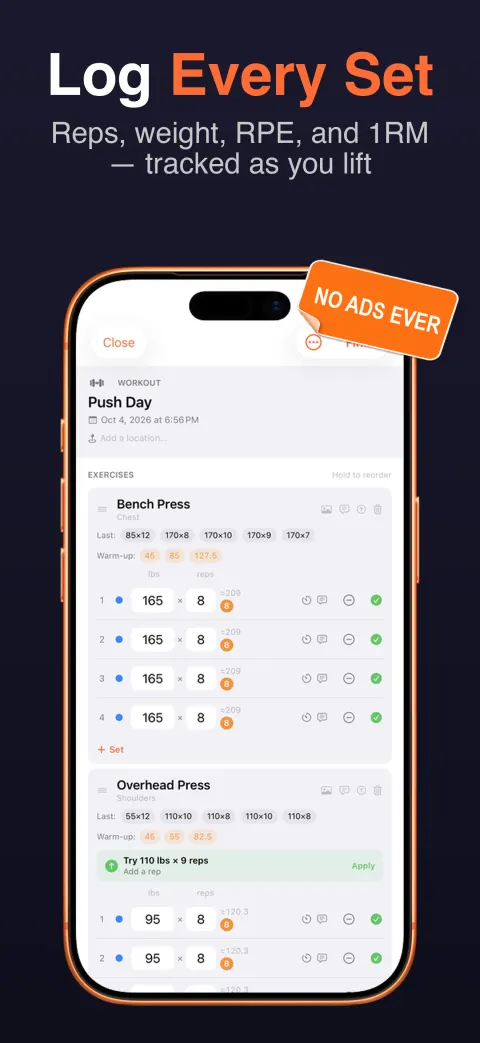
A progressive overload app that does the math
Lift shows last session's weights under each exercise and suggests your next weight or reps, with your own rep range and weight jump. It can hold back when your last RPE was high.


Frequently asked questions
How much weight should I add each week?
Small amounts. The American College of Sports Medicine's position stand suggests a 2 to 10% increase in load once you can do one or two reps more than your target with the current weight. Beginners on simple programs often add the smallest jump the gym allows each session.
What if I cannot add weight any more?
Add a rep, a set, or better form at the same weight first. When progress stalls for a few sessions in a row, reduce the weight about 10% and build back up, change the rep range, or take a deload week.
Is progressive overload only about weight?
No. More reps at the same weight, more sets, more training days, or the same work with better control all ask more of the muscle. Weight is just the easiest to measure.
Is there a progressive overload app?
Most workout trackers help. Lift shows your last session under each exercise and suggests the next weight or reps from it, with settings for your rep range and weight jump.